Insight, Trend
The Genie Meter Is On: What Databricks' New Pricing Says About the ROI of GenBI
Databricks turned the Genie meter on, and agents get no free tier. Why full autonomy makes an agnostic GenBI layer, any model on any platform, the whole decision.
Howard Chi
Updated: Jul 25, 2026
Published: Jul 25, 2026
On July 8, Databricks turned the meter on. Genie is now pay-as-you-go. Each user gets that free monthly allowance, and everything past it is billed in DBUs based on the underlying model usage. Compute for the queries themselves is billed separately, on top. And one line in the pricing and budgets docs deserves more attention than it's getting: service principals get no free allowance at all. They're billed from the first token.
This is a reasonable way to price the product. Inference costs money, free tiers were always a promotional period rather than a business model, and shipping budget controls alongside the pricing is more transparency than most vendors offer. Genie is a good product and the lakehouse under it is excellent. The interesting part is what that line about service principals gives away, because it tells you where the industry's GenBI economics are headed, and it should change what you ask during an evaluation.
The question you're really deciding isn't what GenBI costs per seat. It's whether the layer your agents reason through is one you can point at any model, on any platform, without asking permission. Autonomy is what you're buying. Agnosticism is what makes it yours.
The workload you're buying for isn't human
Every roadmap I see, ours included, points the same direction. Within a year or two, most analytical questions won't be typed by a person into a chat box. They'll be asked by agents, over MCP, as a step inside some larger workflow: a pipeline that checks whether yesterday's numbers moved before it fires, a support agent pulling account history mid-conversation, a forecasting job that interrogates the warehouse forty times to assemble one answer. Nobody is watching those questions go by.
That's what full autonomy actually means, and it changes the shape of the workload in three ways that matter more than any per-seat price.
Volume stops tracking headcount. A human asks a handful of questions a day and goes home. An autonomous system asks whenever its trigger fires, at whatever hour, as many times as its reasoning requires. On Genie's pricing that traffic runs through service principals: no free allowance, billed from the first token, per call, forever. The whiteboard sentence I'd put in front of any GenBI decision this year:
Agents don't get a free tier. Price your GenBI for the traffic you'll have in two years, not the pilot you're running this quarter.
Rationing becomes an outage. Look at what a "block usage when exhausted" control means once the caller is a machine. For a human it's an annoying month. For an autonomous workflow it's a dependency that returns nothing halfway through the month, inside a pipeline that has no fallback and no one reading the error. A budget alert is not a cost strategy, it's a smoke detector, and a hard cap on an autonomous system isn't a cost control either. It's an off switch you've handed to your own invoice.
Accuracy stops being self-correcting. This is the part I'd worry about most. When a human gets a wrong answer, they notice the number looks off and ask again; the retry is the safety net. Remove the human and nothing checks the answer before it becomes an input to the next step. A wrong answer doesn't cost you a query, it propagates. Which means the layer feeding those agents has to carry your actual definitions of "net revenue" and your actual join logic, so the model stops guessing at them. Phison runs Wren across 20+ databases fully on-prem, which is exactly the setting where that grounding has to hold up on its own, with no hosted frontier model to fall back on.
Why agnostic is the whole game
If you haven't run into us: Wren AI is an open-source context layer and GenBI engine that sits between your warehouse and whatever model or agent is asking the question. It runs on your lakehouse rather than replacing it, with native Databricks support built in.
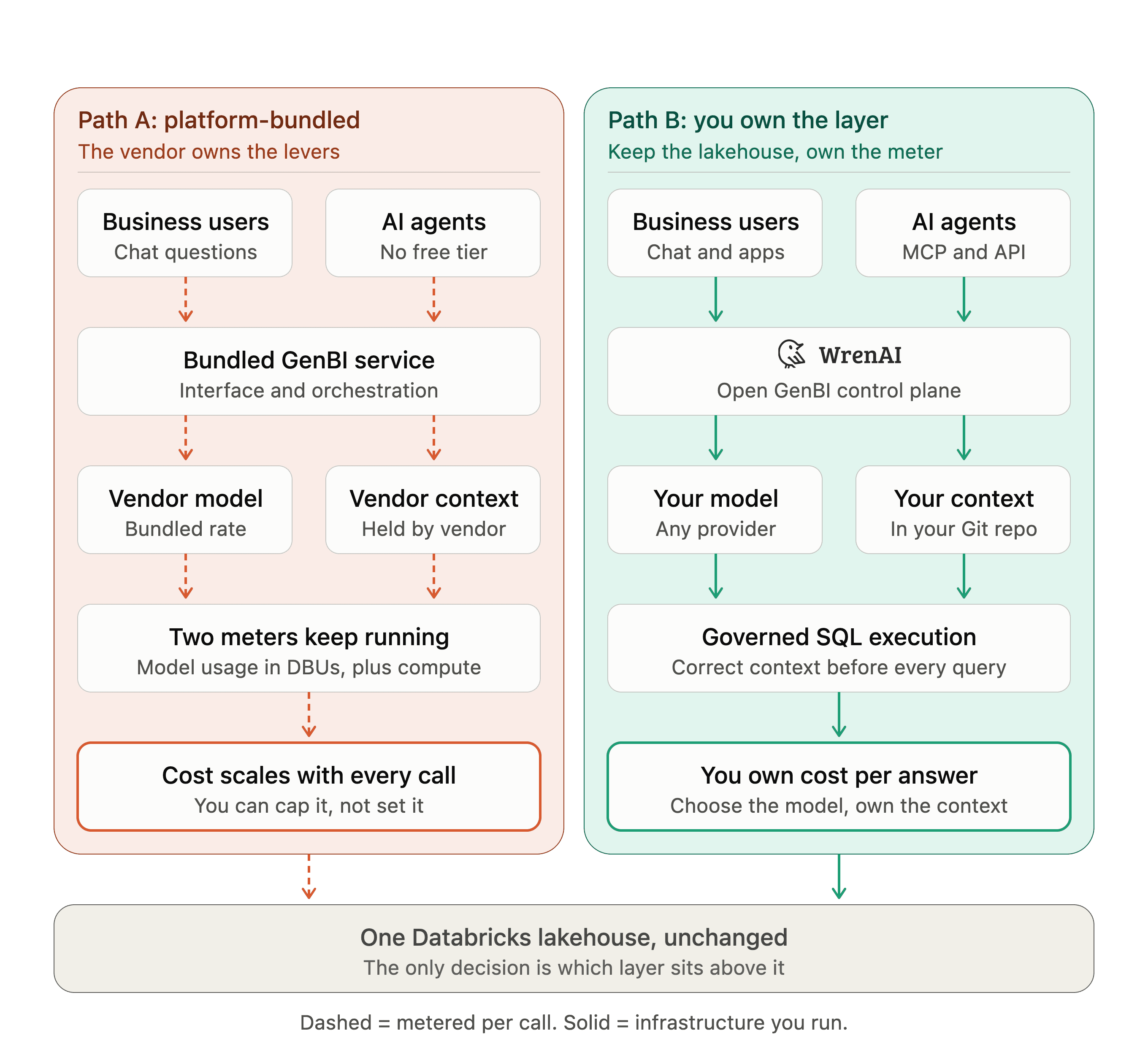
Notice what doesn't change between the two paths: the lakehouse. Same tables, same governance, same platform. The only thing being decided is which layer sits above it, and whether the levers in that layer are yours.
We built it agnostic on purpose, and autonomy is the reason. An unbounded, unattended workload is exactly the wrong thing to run on rails you don't control. Three axes, and you want all three:
1. Model-agnostic. Point Wren at OpenAI, Azure OpenAI, Bedrock, Vertex, or a model you host yourself. If you have an Azure commitment sitting unspent, spend it down instead of paying a second meter on top of it. For heavy autonomous volume, a self-hosted open-weight model turns per-question pricing into flat infrastructure cost, which is the only cost structure that survives a workload that grows on its own. And when a better or cheaper model ships next quarter, being agnostic means you switch. On a bundled meter you file a feature request, and every price improvement in open-weight inference accrues to your platform vendor instead of you.
2. Platform-agnostic. Your definitions of "net revenue," your join logic, your accumulated corrections live as MDL in your git repo, reviewed in pull requests like any other code. That keeps the warehouse underneath swappable and it means nobody bills you per question for consulting your own business logic. It also decides how a renewal conversation goes: "we'd have to rebuild a decade of definitions" is not a negotiating position, it's a hostage note you wrote yourself.
3. Agent-agnostic. This is the axis teams miss. Answers that live inside one vendor's assistant are reachable by that assistant. The agents that will actually be asking your data questions are scattered across your stack: Claude Code in an analyst's terminal, Cursor, a copilot inside your own product, a vendor's agent in your workflow tool. An agnostic layer serves all of them the same definitions over MCP, so "what does net revenue mean" has one answer no matter who asks. Otherwise every agent you add relearns your business from scratch, and they won't all learn it the same way.
The obvious objection
Today, sure. But you're not signing up for today's price, you're signing up for a structure: an unbounded, increasingly unattended workload, metered per use, on a bill you can cap but not control. Introductory rates on a meter only move in one direction once the workload is entrenched, and the budgets-and-alerts tooling Databricks shipped alongside the pricing tells you they expect this line item to need managing.
The stronger objection is that agnosticism has a cost. You run a component, you pick a model, you own the definitions in a repo. Bundled is genuinely less work on day one. The trade is that those day-one savings shrink exactly as the stakes rise, at the point where analytics stops being something people click and becomes something your systems depend on unattended.
Five questions to ask before you sign
If you're mid-evaluation, these are the ones I'd put in front of the vendor and in front of your own team. They're useful whether you end up choosing Genie or not.
- What share of our questions will come from agents in 24 months? Not seats. Calls, including the unattended ones arriving over MCP. Price that number, not the pilot's.
- What happens to an autonomous workflow when the budget cap trips? Ask to see the failure mode, not the alert. A pipeline that silently returns nothing mid-month is an incident, not a line item.
- Can we point this at inference we already pay for, or host ourselves? If the answer is no, you've accepted a per-question rate you don't set on a workload that grows without you.
- Can every agent in our stack reach the same definitions? Or only the ones inside this vendor's product?
- Do our definitions leave with us? If we move in three years, does "net revenue" come with us as files we own and can diff, or does it stay in the vendor's UI?
Question 5 is the one teams skip and regret. The rest are terms you can renegotiate.
Keep the lakehouse. Own the meter.
None of this is an argument for leaving Databricks. The lakehouse is excellent, and nothing here moves a single table. It's an argument about which layer you own.
Your data platform should be swappable infrastructure underneath a context layer you control, pointed at a model you choose, reachable by any agent you run. That was true before July 8. The difference is that now it's written on an invoice.
The free period for GenBI is over across the industry, and honestly, good: real prices force real architecture decisions. Just make sure the layer your agents end up reasoning through is one where you own the lever.
So here's the one ask, and it's not "don't use Genie." It's test the autonomous case before you commit, because that's the workload you're actually buying for. Take the twenty questions your business users ask today, then point an agent at them over MCP and run them unattended, both ways: through your Genie pilot, and through Wren AI on the same lakehouse with a model you already pay for. Watch what each one costs, and watch what happens when you cap it. It's Apache-2.0, so that comparison costs you an afternoon rather than a procurement cycle.
See governed GenBI in action
Watch short demos of Wren AI turning business questions into governed SQL, charts, and reusable GenBI apps.
Watch product demosThe Wren Journal
Get the next deep dive in your inbox
Practical GenBI guides, product updates, and customer lessons from the Wren AI team. A couple of emails a month, no noise.