Zero Joins, Infinite Insights: 3 HR Use Cases for Wren AI
HR data is often trapped behind complex SQL joins and busy analyst schedules. Discover how Wren AI democratizes business intelligence by allowing anyone to query employee data using natural language.

Pin Chang
Updated: Jan 21, 2026
Published: Jan 21, 2026
In the modern workplace, Human Resources is no longer just about "people skills" - it's about data. From managing turnover to ensuring pay equity, HR leaders are expected to make high-stakes decisions based on complex datasets.
However, there's a bottleneck: most HR data is trapped in relational databases. To find out something as simple as "the average salary of women in the Marketing department," an HR professional usually has to wait for a busy Data Analyst to write a complex multi-table SQL join. Wren AI changes this dynamic by allowing anyone to query their HR database using natural language. Let's look at three real-world scenarios based on a standard HR dataset
Pro Tip: In this dataset, active employees are flagged with a 9999 end date. To avoid skewing our averages with partial-year data, our analysis focuses on full-year cycles up to December 31, 2000, providing a clean and reliable baseline for our HR insights.
Scenario 1: Bridging the Gender Pay Gap
The Challenge: Your leadership team wants a report on pay equity to ensure the company meets its Diversity, Equity, and Inclusion (DEI) goals. The Manual Way: An analyst must join the employees table (to get gender) with the salaries table (filtering for current pay) and the dept_emp table (to segment by department). One wrong filter on the to_date column and the entire report is inaccurate.
In Wren AI, you can simply ask:
"Show me the average current salary by gender for each department. (show the difference in percentage)"
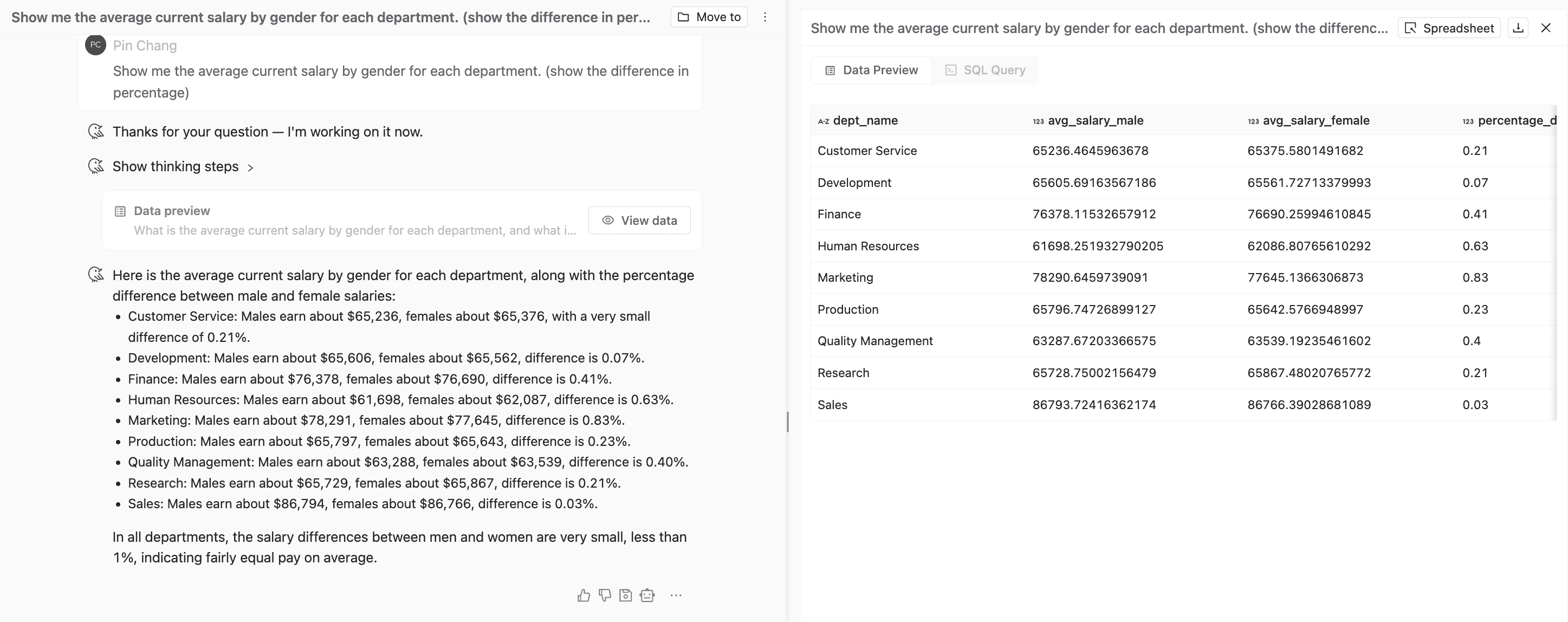
Insight: The data reveals an exemplary state of pay equity, with gender pay variances across all departments remaining under 1%. This confirms that current DEI initiatives are highly effective. Specifically, the Marketing department shows a minor variance of 0.83%. While this is still well within the threshold of equity excellence, having this level of granular visibility allows HR to monitor the trend proactively and ensure the gap remains closed, maintaining the company's status as an equitable employer.
Scenario 2: Strategic Workforce Planning (Tenure & Retention)
The Challenge: You notice a spike in resignations and need to know which departments are most at risk based on employee tenure. The Manual Way: Calculating "Tenure" requires complex date math (Current Date minus hire_date) and joining with the departments table. Most HRIS tools make it difficult to see this trend across the whole organization at once.
You can ask in Wren AI:
"What is the average tenure of employees in each department? (exclude the employee who works until year 9999)"
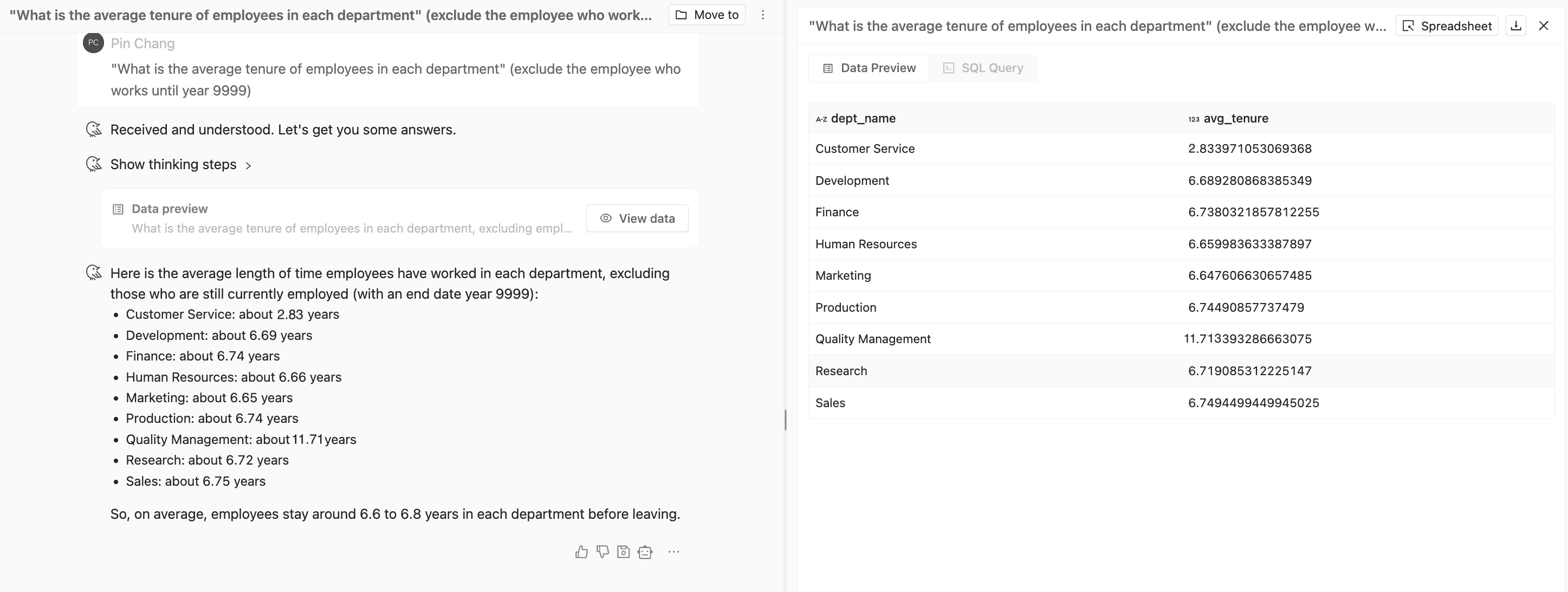
Insight: You see that Quality Management has an average tenure of 11.7 years, while Customer Service is at 2.8 years. This data-backed evidence allows you to propose a specific retention bonus or training program for high-turnover departments.
Scenario 3: Real-Time Budget Optimization
The Challenge: It's budget season. Finance needs to know the total "run rate" (total salary expenditure) for every department to plan for next year's headcount. The Manual Way: You have to sum up thousands of records in the salaries table while ensuring you aren't counting "historical" salaries for people who have received raises or changed roles.
You ask:
"What is the total annual salary expenditure for each department in year 2000?"
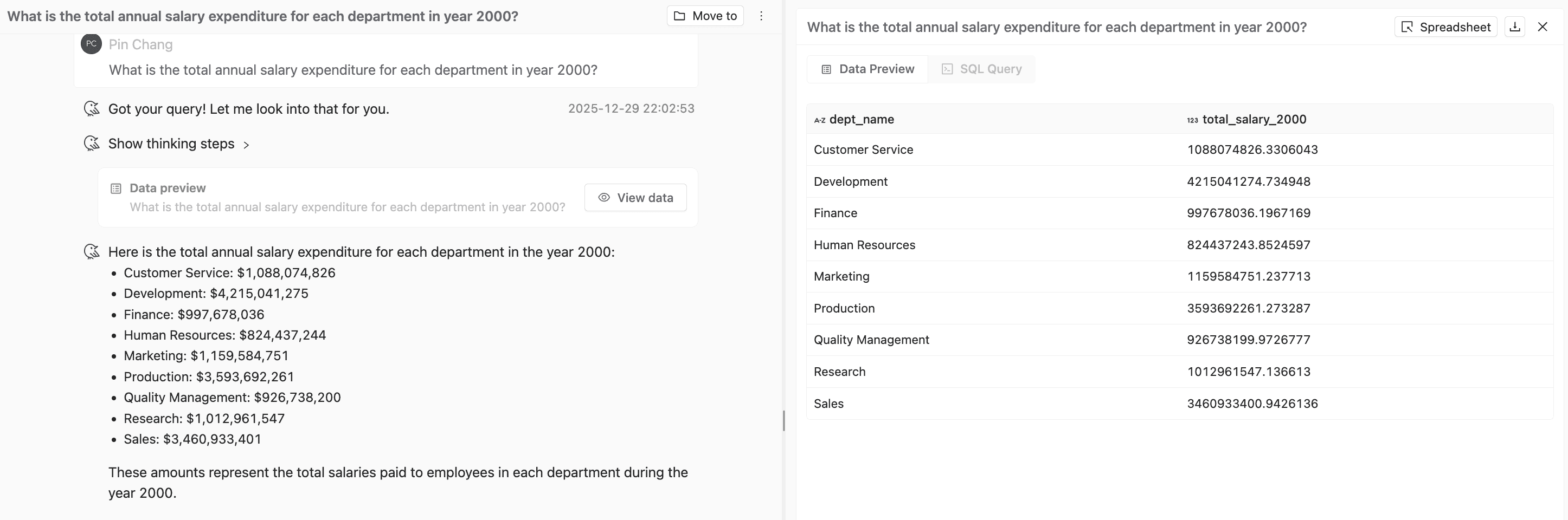
Wren AI filters for the most recent salary record for every active employee and aggregates them by department name.
Insight: You realize the Production department's budget is 20% higher than projected due to recent promotions. Instead of waiting weeks for a manual audit, you have the numbers in seconds to adjust your hiring plan.
Why Wren AI for HR?
By using Wren AI with your employee data, you move from reactive reporting to proactive strategy:
- Speed: Answer board-level questions in seconds, not days.
- Accuracy: Remove the human error associated with manual spreadsheet exports and VLOOKUPs.
- Empowerment: Allow HR Business Partners to explore data themselves without needing a technical background.
Ready to transform how your organization accesses data? Request a demo or start your free trial at getwren.ai
Supercharge your data with AI today
Join thousands of data teams already using Wren AI to make data-driven decisions faster and more efficiently.
Start Free TrialRelated Posts
Conversational BI Empowering Self-Service Analytics with Wren AI’s GenBI
Self-service analytics has reshaped business intelligence (BI) by enabling non-technical users (marketers, customer success managers, executives, and operations teams) to explore data independently, without relying on data experts.
Aug 20, 2024Can AI Solve Data Silos Challenge? New Challenges To The Multi-AI Agents Era.
In this post, we are going to discuss what businesses encounter data silo challenges before the LLM era and the new hope LLM brings to the data ecosystem, and finally, we will explore some of the new challenges that emerge when we are using more vertical LLM agents to solve different purpose of scenarios.
Feb 13, 2025From Traditional BI to GenBI Embracing a Smarter, More Human Approach
How Generative BI Transforms Data Analytics with AI-Powered Insights and Human-Centric Decision Making

Keep reading
 Product
Conversational BI Empowering Self-Service Analytics with Wren AI’s GenBI
Self-service analytics has reshaped business intelligence (BI) by enabling non-technical users (marketers, customer success managers, executives, and operations teams) to explore data independently, without relying on data experts.
 Insight
Can AI Solve Data Silos Challenge? New Challenges To The Multi-AI Agents Era.
In this post, we are going to discuss what businesses encounter data silo challenges before the LLM era and the new hope LLM brings to the data ecosystem, and finally, we will explore some of the new challenges that emerge when we are using more vertical LLM agents to solve different purpose of scenarios.
 Product
From Traditional BI to GenBI Embracing a Smarter, More Human Approach
How Generative BI Transforms Data Analytics with AI-Powered Insights and Human-Centric Decision Making